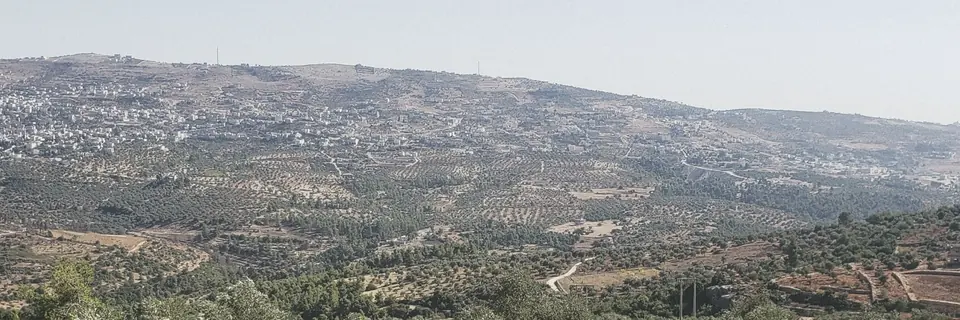
A hillside held up by its walls
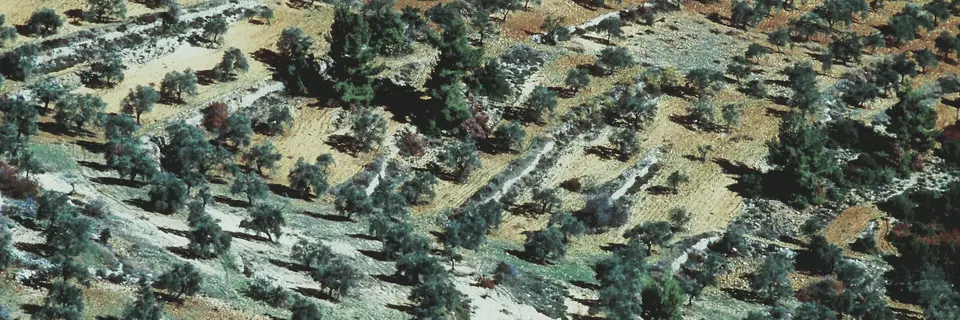
The estate runs down one slope below the road to the forest reserve: about eleven hundred Nabali trees in rows, each row behind a dry-stone wall with a strip of red soil. None of them is ever watered, and all of them are picked by hand.
Red earth, white stone
Under the trees is terra rossa, the red soil of Jordan’s wetter north-west, lying over limestone. It holds the winter well. The limestone is everywhere: it comes up with the plough, and it is what the walls are made of. Around us the hills are oak, wild pistachio and strawberry tree, and the Ajloun forest reserve begins further up the road.
In August the soil cracks wide enough to lose a pen in.
Where the name comes from
Sanasel is what our grandparents call the dry-stone walls that hold the terraces: stones laid without mortar, the big ones at the bottom, the small ones packed in behind so that water can pass and soil can’t. A wall like this lasts exactly as long as someone mends it. Every August, after the stone has hardened in the fruit and before the first rain, we walk the terraces and put back what the winter took down.
The year on the slope
Now
Kanoun al-Thani
January
Rain. We stay off the terraces so the wet soil isn’t packed down.
Now
Shbat
February
Pruning, once the last oil is bottled. The cuttings go to the goats and the stove.
Now
Adar
March
One shallow ploughing between the rows.
Now
Nisan
April
Buds. Our grandmother watches for frost.
Now
Ayyar
May
Blossom. A hot east wind now can cost us the year.
Now
Haziran
June
Fruit set. Most of the flowers have fallen; the ones that stayed are the harvest.
Now
Tammuz
July
The stone hardens. Our only job is not to water them.
Now
Ab
August
We mend the walls.
Now
Aylul
September
The fruit fills with oil. We book the press nights and wash the sheets.
Now
Tishreen al-Awwal
October
The first rain. Then Tishreen.
Now
Tishreen al-Thani
November
Picking every day, guests on Fridays and Saturdays. Al-Jdeed is bottled.
Now
Kanoun al-Awwal
December
Kanoun: the ripe fruit, the last sacks, the last night at the press.
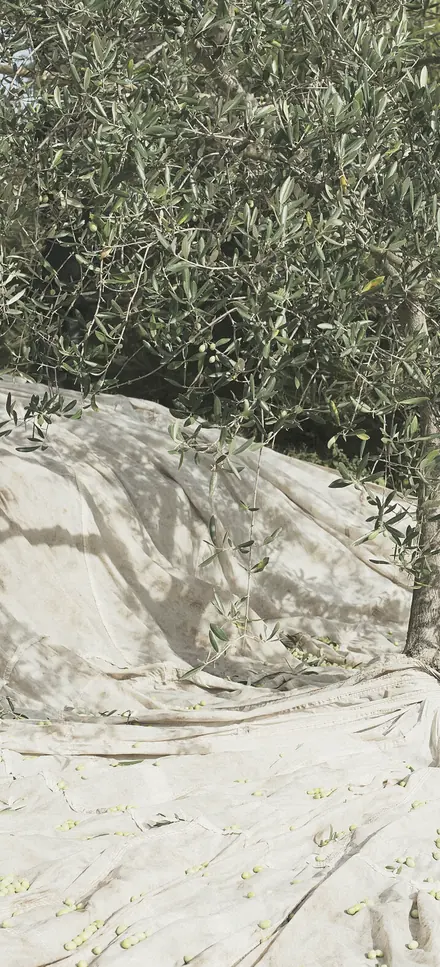
Nothing waits until morning.
The sheets go down under the first tree after breakfast, and we comb the branches with short plastic rakes; a stick brings the fruit down faster and breaks next year’s shoots. The same families from Orjan have picked beside us for years, paid by the day, and at lunch they eat before we do. By the afternoon the sacks are filling, open sacks, never plastic bags, and they are tied and on the pickup before the sun goes down behind the hill. Olives left overnight in a sack start to ferment, and you can taste it in the oil.
We don’t own a press.
We book a modern press near Ajloun town for the first hours of the night, after it has finished with the village’s olives and before it starts on anyone else’s. The line is washed before our fruit goes in. The paste is kept below 27 °C, which is what “cold extracted” means, and the oil goes into steel tanks under nitrogen to settle. We bottle in small runs through the winter, by hand, at the house.
Read about one of those nightsWho does what
- Our grandmother decides when the picking starts. She is usually right about the rain.
- Our father walks the walls and keeps the press bookings in a school notebook.
- Our brother, the eldest, runs the harvest days and cooks the makmoura.
- Our sister, the youngest, does the bottling, the labels and the words on this website.
- The families from Orjan who pick with us, and the press master who opens the door for us at night.